
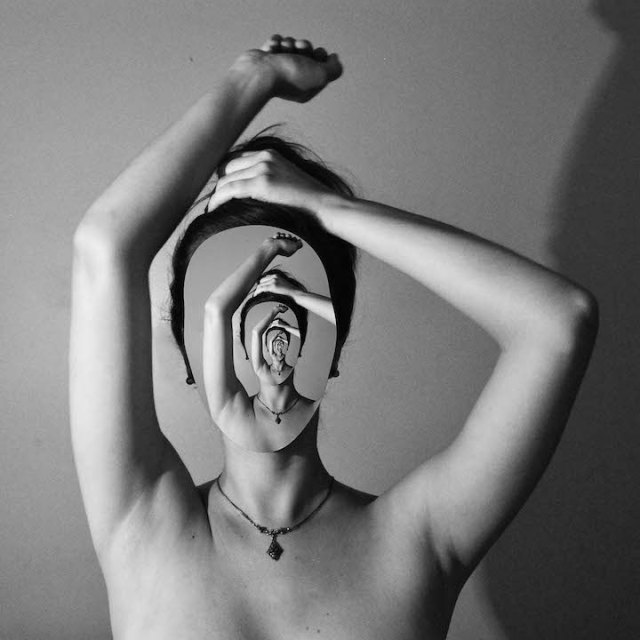
It is not at all clear why the phenomenological experience should take the Self as its starting point of investigation. The Self seems to be an, as yet, untested hypothesis, itself in need of empirical justification. Far from being foundational, we are now aware how late the concept of the Self is in human development (see the work of Daniel Dennett and Thomas Metzinger).
It is no longer satisfactory to speak of the Self with one voice. Rather, there is a plurality of selves, multiple voices, overlapping and discontinuous, a map without definitive boundaries or horizons of experience. There is, first of all, the so-called “minimal self”, primitive, immediate, rooted in the neurological structure of the brain. There is the “narrative self” acting as a continuity of memory and personal identity, a rich tapestry of stories, encounters, reflections, deceptions. There is the “social self” mirroring and absorbing its surroundings, the environment of culture, beliefs, norms. It would seem that our basic starting point was no longer a single point at all, but a diffuse, decentered mode of experience.
Still, the desire for unity remains. It is hoped that if we could only discard what is secondary and inconsequential, we will arrive, at last, at a basic substratum, an immediate or primal constitution that we call the “real” Self. It is hard to rid ourselves of the metaphysical conception of “essence”.
It is to this end that AI mapping hopes to unveil the “essence” of cognition, and incidentally, also while it will fail for the problem of the Self is not one of essences, but rather of discontinuities.
The notion of an “essential self” would seem to involve not a single, fixed element by which we can identify and name something, but rather, a way of relating to things. The problem with such an approach, as Derrida points out, is that it ensnares us in the metaphysical quagmire, that of “self-presenting = the present”. Moreover, phenomenological experience assures that no single identity could exist across a given amount of time. Instead of a Self we have what might be called self-situations. At best, we might hope to replace the notion of the essential with something akin to an organic biological conception.
 The Hack