
A police officer pulls over Werner Heisenberg for speeding. “Do you know how fast you were going?” asks the cop. “No,” Heisenberg replies, “but I know exactly where I am!”
Category: Science
The First Mistake
The First Mistake of Design (one of many): “We do not expect to see regularity produced by a random process.”
Vegans
Not the people who don’t eat meat or animal products, but the aliens clustered around the star Vega in the Lyra constellation. The signal was weird. Not a prime number series, but what I can only imagine was a Vegan joke. The signal went:
What happens when 100 Cepheids screw in a standard candle lightbulb?
Hubble sperm.
Maxwell
“The vast interplanetary and interstellar regions will no longer be regarded as waste places in the universe, which the Creator has not seen fit to fill with the symbols of the manifold order of His kingdom. We shall find them to be already full of this wonderful medium; so full, that no human power can remove it from the smallest portion of space, or produce the slightest flaw in its infinite continuity.”
The Purpose of My Art
My art is predicated upon four foundational principles:
1. Relativity – A projective geometry. Perspectives change, but we each experience the same (valid) edifice or structure.
2. Symmetry – A projective description. The totality of perspectives unite into the same edifice.
3. Invariance – The intermediate unchanging connections or conditions that allow relativity and symmetry to unfold. A kind of pre-geometry, table, stage, field, or lattice upon which calculations can be performed.
4. Complementarity – Mutually exclusive within our local domain. You cannot paint the Sistine Chapel on top of the Mona Lisa. So choose wisely.
Free Will or Agency?
There are philosophical ideas that run headlong into the scientific method that generate strange debates. Not the fruitful kind, but ones that feel more like semantics and equivocation. The best example is the zombie debate between free will vs. determinism. Really? This again? I can’t wrap my head around it. Are there philosophers still asserting that there is something intrinsically non-physical about human agency? At a certain point, we coarse-grain the distinction away. I have agency. I can reach for the pen, or not. This is not free in the sense that an absurd number of causal factors went in to constitute my ability to make that decision (evolving from a single cell organism to a fully constituted human being with arms, fingers, an opposable thumb, nerves, spinal cord, and a brain). Nor is it against my will (God, or Jigsaw, is not forcing a gun to my head demanding a hard choice). The choice is to all extent and purposes superfluous, for Natural Selection gave me the power to choose and will ultimately decide whether my choice was a wise one. Is this free will? No, it’s an intentional act, it’s agency. Physical systems have evolved to allow some things (me, you, alive things) to be able to perform intentional acts. The mystery is why anyone thinks there is a metaphysical mystery.
The other side of the debate sometimes pushes the line too far. In an attempt to assert the undeniable fact that humans are governed by the same laws of physics as rocks (yawn), a hard determinism attempts to deny intentional acts. Wait? I thought we were debating free will? Are we now denying the existence of volition in general? Oh please. No one seriously believes this. When the waiter gives me my choices to drink “coffee, tea, or water” and I say coffee, am I supposed to curse an evil God who secretly programmed me to make the decision he alone wanted? What kind of madness is this? Push that line of thinking and you’ve not elevated determinism. You’ve simply elided a key distinction between life and non-life. One of the reasons I am able to distinguish rocks from life (a key differentiator) is an ability to produce a complex range of directed, purpose-driven behavior. The choices are the environment, life negotiates that space. And we call this agency, intention. That’s not a rejection of determinism, hard or soft. It’s just not instructive, not instrumental to a discussion of what is happening. It’s akin to the waiter saying “Coffee it is, but what is the point? In the end we are all dead.” Technically, it’s not even true. But philosophically, it’s non-severable.
If we say a complete physical description is impossible by a strict reductionist method, that there is some secret sauce that is needed to explain intentional acts and in particular consciousness, surely we are not committing to the idea that this special sauce must be non-physical? Is free will merely an attempt to smuggle magic back into our world? Why? The world, governed by physical laws grasped by mathematical equations, is quite magical to behold. You don’t need to smuggle anything. Or better still, as artists would say, there is a magical way in which Hobbits and Elves do inhabit and exist in the world regardless that no fossil record of their physical existence will likely be found. The universe is always much larger than we initially are led to believe. The greatest act of freedom is the power of our imagination.
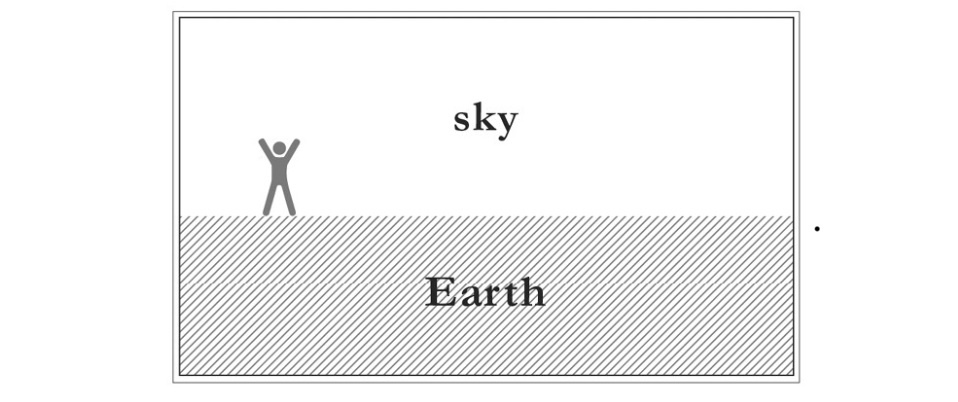
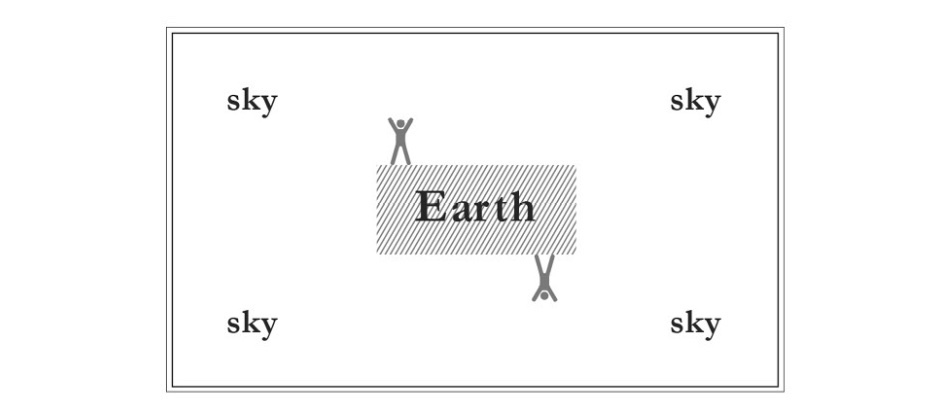
The Flat Earth Challenge
Not this:
This:
Notes on the Foundations of Physics
Arrow of Time: You don’t need a special initial condition. The reason entropy is lower in the past is an effect of quantum mechanics. Take the Schrödinger Equation evolving over time into a superposition of Cat Dead, Cat Alive. An electron interacts with the system, becomes entangled with the system, creating a single measurement outcome, one with a single recorded past (I’m an optimist, so let’s say Cat Alive). Decoherence guarantees the branching, one with a single recorded effect, the other branching away into the unobserved unrecorded. The future (from our position in the global wave function) isn’t recorded, therefore thermodynamic processes will always increase (entropy will always go up, increase). Unitarity guarantees that entropy will always be lower in the past because the past matters (there are less connecting branches, or better still, less complicated entanglements, correlations, configurations). To see this, let’s become pessimistic (The cat died). Let’s run our quantum experiment again, placing a dead cat into the experiment. The state will evolve to a mixed state (Dead cat 1 and Dead cat 2). We open the box, perform our measurement and…well, I’m not sure which version of the dead cat we have. But one thing my prediction can safely rule out. No miracles. The cat won’t come back to life in violation of unitarity. This also takes the mystery out of the measurement process. Measurement is quantum recording of a given quantum state. It is a basic function of quantum unitary evolution. You don’t need minds, or God. QM takes care of the whole operation. The apparent wave function collapse is explained because the past is what is measured, recorded, supervened.
Complementarity: It is built into the Schrödinger Equation, it’s what drives the branching effect. Decoherence is the process that gives the geometry that allows the architecture in which we can speak of a plurality of worlds. “The strong form of complementarity, which takes it beyond relativity, is this: There are many equally valid views of your subject—perspectives, in the general sense of that word—but they are mutually exclusive. In the quantum world, we can realize only one perspective at a time. Quantum cubism is a no-go.”
Boltzmann Brains: Black Hole entropy is fundamental. Quantum Information does not fill in the volume of space; therefore our universe is not globally ergodic. BB is ruled out. Nature is giving us an important clue, a flashing light actually at the event horizon. Warning: A (globally) maximum entropic state is not possible. Proceed with caution.
Black Hole / White Hole: Two sides of the complementarity coin. Outside, it appears as a black hole, inside it appears as a white hole, a Plank star. The energy dissipates from one universe into the creation of another universe. Biology now supersedes physics as each universe gives birth to a new one, diluting matter and radiation from one universe compressing it into low entropy, high-quality energy to start the birth cycle anew. The gate closes, and evaporates away. Another Universe takes hold. And you can’t get there unless you are there. Just like I can’t get to the 2nd BCE of Ancient China. Was information lost? From this (local) universe, yes. But globally (from the multiverse) information is retained in the glow of a New Big Bang.
Time and Entropy
The arrow of time is often explained in terms of entropy. The seemingly irreversibility of time is the result of our universe moving from a state of lower to higher entropy. This is easy enough to grasp. We are more likely to see the falling glass shatter into pieces than the shattered pieces coming together to form the glass.
I wonder, though, if time and entropy may have a deeper connection than this simplified version of our standard theory suggests. It’s a muddled picture in my mind, made less clear by a lack of mathematics. More like fragments of random observations. The simplistic image goes something like this: assume four dimensionless points (I refrain from describing these points as particles as that can lead to conceptual problems). Why only four? I wish to draw a square to make the geometry more straightforward, that’s all. These points don’t exist in spacetime. They do not fill anything or take up space. They have no connection to each other. They do not self-interact.
What do these points consist of then? A number, that is to say, they have an intrinsic or spin angular momentum. Because there is no connection, these isolated points have no inertia (Mach’s principle). There is no space between them because there is no connection field. So where do these points exist? They are not embedded in spacetime for the point of the exercise is to predict the very existence of spacetime emerging as a connecting field takes hold.
For simplicity sake, let us say that these points (and here, let us begin calling them Q-bits to liberate these points from our common association with particles) exist within a complex topological boundary where spacetime is unable to exist within the regime of a non-inertial connection. Space isn’t expanding “into” anything. Space remains fixed to its initial boundary conditions while the formation of a connection field gives rise to inertial forces that “project” or map out the space of a concrete geometry (in this case a square). The boundary conditions can be described through a scalar field mapped onto the complex space (the stress-energy tensor of general relativity). Conceptually, these connecting fields are identified through their so-called duality frames.
A complete muddle. So what drives these four Q-bits to converge and form a connecting field? What is the combination? Is it like a slot machine where a lever comes up with a random pattern – heart, diamond, cherry, lucky7 – no jackpot, no connecting field? Another random pull yields a new kind of pattern – say all four lucky7s – jackpot! A connecting field emerges. Why and how did this symmetry break? Perhaps the laws of quantum mechanics do not allow four Q-bits to share the same spin. Thus, a connection field entangles the Q-bits in order to conserve angular momentum through a more complex geometry of spacetime. No information transfer is needed across each point. Entanglement ensures the eternity of spacetime.
Time, in this sense, is flattened, pancaked, localized space. Time is a rebounding effect or echo as a state moves from lower to higher entropy and space itself expands. Space is non-localized time. Entropy is the well curve for any defined “closed” system along the world line/sheet/volume.
Speculation without an equation.
Entropy in such a picture would emerge from an intrinsic conservation of angular momentum. The state goes from simple order (lower entropy state) of four independent points to a more complex organization (higher entropy state) with a connecting field representing a value in each point of space.
But this is all a muddle, and being an amateur theoretical physicist in one’s spare time is not conducive to real discoveries. As a Philosopher, I enjoy the muddle. Somehow, in ways that are not always clear, a rogue suggestion or an obvious error can lead others to great breakthroughs. And we all share in some small way in these victories.
Ant-Man is Dead. Long Live Ant-Man!
Ordinarily, we think of heavier* things being bigger (larger) than lighter objects. In everyday life, that scale seems to hold. Humans are heavier than ants, the earth is heavier than humans, the sun is heavier than the earth. It’s a natural assumption because we imagine things are made up of composite materials (cells, atoms, electrons, protons). It is natural to think of larger things as being made out of constituent parts known as building blocks.
But the scale doesn’t always hold firm. Although we don’t ordinarily encounter such exceptions in our day to day life, they do exist. A neutron star, for example, is much smaller than the sun, and yet far more massive (a teaspoon of a neutron star would weigh 4 billion tons!). The proton is more than 1,800 times massive than the electron. Yet it is smaller than an electron. It turns out that this intuitive scale is merely a rule of thumb, not as an iron-clad law of nature
Wait did you say the proton is smaller than the electron? I don’t understand. Don’t we always see a big old proton surrounded by tiny electrons? What’s going on?
Individual particles are not the particles of our classical understanding. Quantum mechanics came along and radically upended our view of reality at subatomic scales. What we call particles are actually excitations of fields. The world is made up of fields, and particles arise out of the interaction of those fields. And what are fields made of? Fields are fields, that’s all, but mathematically they can be described as values at every point in space. Fields can come in all kinds of shapes and forms (spinnor fields, vector fields, scalar fields).
At the quantum level, these fields are described by equations for the wavefunction. For every particle of energy of certain momentum, there is an associated frequency and wavelength. The wavefunction gives the probability of measuring a particle as proportional to the square of the magnitude of the particle’s wavelength (the Schrödinger equation obeying the uncertainty principle).
Given the wavelike nature of these fields, how can we describe a particle’s mass at the quantum level? The relationship between the properties of mass and physical constraints for a subatomic particle is described by its Compton wavelength. The Compton wavelength is given by the formula:
λ = ћ/mc
where ћ is the reduced Planck’s constant, m is the mass, and c is the speed of light. Setting h-bar and c equal to 1 (natural units), we can simplify the formula for the Compton wavelength as equal to 1/m. This also simplifies the underlying relationship between mass and wavelength. As mass goes up, the wavelength is smaller. When measured, you get the following results:
The Compton wavelength for an electron is 2 x 10⁻¹⁰ cm.
The Compton wavelength for a proton is 1 x 10-13 cm
Thus the Compton wavelength is shorter for a proton than an electron because the relationship is determined by 1 over the mass.
In quantum mechanics, heavier particles are smaller in some real sense. This has to do with energy scales (energy = mass correlation). The Compton wavelength determines the smallest size the wave function can be and still safely predict there is only one particle. Think of it as the smallest box we can squeeze a particle into and still stay within a 1-particle regime. Any smaller and energy levels would give rise to a greater number of particles.
In other words you can’t make things out of individual particles that are smaller than their Compton wavelength. There is a minimum size you can squeeze the wave function down to and still call it a single particle.
The idea that we can shrink bigger, heavier things via some miniaturizing device into smaller, lighter things (while fundamentally still being considered the same thing) isn’t just science fiction. It’s forbidden by the laws of physics and the rules of quantum mechanics. 😿😿
Sadly, this also means that Ant-Man will never be real! You can’t shrink down a person by shrinking the individual atoms. Either you must remove individual particles (to keep the person light) or the person will have to become more massive (and thus not a very agile, deft, or effective superhero, more like a superhero that keeps falling through floors).
(*Mass of course is the true measure of the amount of stuff that goes into creating a thing. Weight is a function of gravity, hence we feel lighter in an elevator going down and heavier going up.)
 The Hack