Mind from Matter

We don’t have the exact picture of how organic life evolved from matter. But if we take a step back, the basic contours seem apparent. It’s the entropic two step. Free energy allows simpler systems to organize in complex ways. Complexity emerges as the most efficient way to maximize free energy at the lowest possible energy state, a process known as dissipative adaptation. “An initially disordered collection of particles can adapt their configuration to form an arrangement that more efficiently absorbs energy from the environment, uses it to maintain or enhance orderly internal motion or structure.” And why the need to minimize energy expenditure? To resist the decay, the dissipation that entropy gives rise to. Lower entropy “localizes” while total entropy increases.

Locality arises out of this complexification. Or better still, locality is given a higher degree of privilege (probability) from a total number of arrangements of (quantum) states. A geometry (or something that can be called a geometrical object) emerges as a certain limiting case of this topology of thermodynamic interactions. The state of a system at any one point of localized measurement is therefore dependent upon its degrees of freedom within a complex system.

Consciousness likely arises as a specific case of a localized geometry of particles (atoms, molecules, etc. there is no need to specify constraints since we are talking in generalized terms).

To see this, consider 4 imaginary dimensionless objects, each with a separate (uncoordinated) spin. Each spin reflects a discrete angular momentum that is inherent in the object and not in reference to an external geometric shape or field such as phase space. It is not a matter of simply connecting the bits together into an organized pattern that forms a spin network via some a priori rules of combinations. It is not the spin network that alone gives rise to a localized geometry. Rather, it is that the connection gives rise to a entirely new set of thermodynamic interactions. You no longer have four bits, but a complex space or map of four bits. The whole is greater (in terms of complexity) than the sum of its parts.

Mind from matter then is no simple evolution. Consciousness does not arise merely by combining simpler atoms into larger and more complex arrangements. Rather, a complex system emerges over and above the constituent atoms allowing the law of natural selection to do its incessant work, yielding ever more startling and wondrous geometric shapes and patterns which consciousness is but one small, and perhaps not even the most fitting, result.
Yes, But Unfortunately It’s Not True

It’s a great struggle to unravel a paradigm of understanding. Paradigms have the feature of quickly organizing data and experience within a referential framework. Paradigms have the bug that when data and experience do not conform to that framework, solutions are hard to come by. Systemic bias is not a denial of reality so much as it is an unwillingness to examine the epistemic framework in which reality is processed and understood. A map or a table, if you prefer to speak philosophically. We (all thinkers, not just scientists) will go to great lengths to avoid a paradigmatic upheaval. So many squares will be pounded into circular holes before unlearning what we previously believed was true.

One example is the classical notion that the universe is compromised of matter and forces. It is such an ingrained popular notion that it takes enormous effort to unlearn this dualism. Coupled with the idea that electrons “orbit” a dense proton/neutron core, one learns anecdotally that atoms are mostly made of empty space. Both ideas are false. If electrons orbit the proton like a planet around a sun they would spiral into the core in less than a split second. If atoms were really mostly empty space then it should be rather easy to squish them together, which it is not.

The old paradigm could not account for this evidence. Subsequently, a new paradigm evolved. But here is the thing. Paradigms are not one-off events. It’s not as if we wipe away the old software and add a bunch of new software. Often, we are struggling to find the contours of such a paradigm with only a dim notion of what it might be but knowing well what it cannot be.

It took awhile before a new paradigm emerged, one in which the universe is field-like in nature. In one sense, the world is more abstract and harder to intuitively grasp. The distinction between force and matter is more of a taste than a hardwired empirical fact. In another sense, the new paradigm is much more satisfying, with several Ah! moments. The way in which the inverse square law of EM and gravity naturally jumps out from fundamental wave-like properties of interacting fields and unconstrained force carriers propagating at the speed of light through space. The way in which particles are excitations within quantum fields and are distinguished by those that can share the same quantum state (bosons) and those that cannot via the Pauli Exclusion Principle (fermions).

What is the truth? Our bias is to affirm a conclusion we thought was true. We are humbled by a conclusion that is shown to be false. Rather, we should be focused on a better result. Not “what is the truth” but rather “why is it false?” This is where our hard work begins, both the beginning and the culmination of our efforts.

QM

A theory does not allow you to pick or choose its predictions you like and refuse the ones you dislike. You can’t embrace general relativity yet reject the probable existence of black holes or the possibility of wormholes simply because it leaves an aesthetic bad taste in your mouth. Accept a theory and all its predictions that follow, then compare predictions to evidence/experiment. Whenever prediction and evidence significantly depart, that’s usually a good sign that the theory needs to be improved or abandoned.

The predictions of QM are straightforward enough. If you accept a probabilistic interpretation of the Schrödinger equation for a wave function evolving through time, then a continuous superposition of quantum (eigen) states will reduce to a single state when observed. The predictions do not allow you to categorically declare the observable state is the one, true, real state while the superposition is somehow unreal, an illusion, or simply a mathematical artifact.

At first blush, it is hard to understand why this result should cause so much consternation. The idea that the (relatively speaking) calm reality of our everyday existence emerges from a sum of fuzzy probabilistic microstates is fascinating, with its own set of questions. Does space itself emerge from this process? Does time? Is there only one way this picture resolves, or are there several copies each with its own separate reality? What happens to all those other worlds? Can we detect them by experiment? What does it mean to observe? What counts as a measurement?

None of this would bother us if the other predictions of QM did not conform with such exact precision to experiment. It’s apparent success leads us to accept all of the predictions. The real question is why does this bother us? Is the prediction anymore bizarre than a black hole or the speed of light being constant? A result can not be judged as nonsense simply because it doesn’t conform to normal everyday observation. Especially since normal everyday observation is inherently a brute cudgel of guesswork.

Science with the aid of powerful mathematical ideas has incessantly led us to shrink the dominion of the kingdom of humankind. From the center of God’s eye, we became a lonely little world of remote significance on the grand stage of the universe. Most scientists accept this fate, but QM for whatever reason seemed a bridge too far for many. You can reduce my domains, but how dare you take away my uniqueness! The violation of a uniform self, the last protected sphere of an infinite conscience, multiplied and stretched out across a (perhaps) infinite Hilbert Space became the straw that broke the camel’s back. Here, we must object! Here we must draw the line and make our final stand against this inerrant assault on humanity’s greatness and fortune.

But this is not science. It is faith. And until we break the arrogance of faith, our science will suffer, has suffered, has stalled on the fear of the power of imagination to build upon the foundation of QM. Is QM the final say? Of course not. But we will go no further so long as we insist on reducing scientific interpretation to mere positivism.

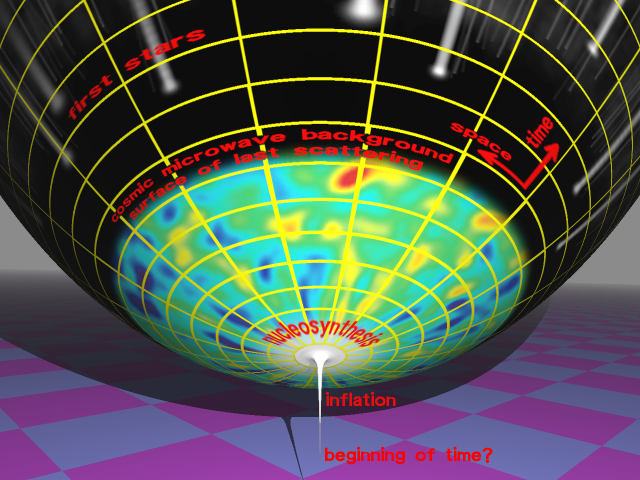
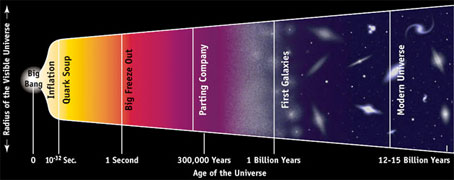
Notes on Inflation Theory

image

No energy is needed to create a gravitational field. The energy released in the creation of a gravitational field is negative. Energy is always released by the creation of a gravitational field. The total energy of the universe could be zero!

If gravity causes the mass of a sphere to contract, energy is released and a new gravitational field is created between the previous position and new position of the shell. Since there was no gravitational field there before, there was no energy. The creation of a new gravitational field extracts energy from the shell, decreasing the energy contained in the new gravitational field. Therefore, the final energy created by gravitational field is negative. On a small scale this is almost trivial, but on a cosmological scale, total negative gravitational energy would be significant.

Once inflation begins, it’s eternal.

There may or may not have been a beginning to the universe.

Our universe is a pocket universe, one bubble inside numerous others (multiverse). Our Universe is much larger than the observable one.

Cosmology

image

Assumptions

1) Infinite, flat space – observations to date suggest that curvature is negligible and is essentially flat. You could have a Ms. Pac-Man situation where if you traveled long enough on one side of the flat surface, you reappear in the same space on the other side. Inflation theory generally predicts a flat, infinite space).

2) Uniform distribution of matter – With the WMAP, there is remarkable agreement with experimental data. The so called fractal or island universes aren’t supported by the evidence. There appears to be an upper limit to the kinds of superstructures or groupings of astronomical objects (e.g. superclusters).

3) Dark whatever’s – Even assuming dark energy could eventually rip apart matter and disperse energy so that there is no mechanism by which they can “relump” to allow a Big Crunch.

4) Quantum foam – uncertainty principle tells us that even in extreme thermal coldness near absolute zero, given a long enough period of time, matter and energy will suddenly pop back into existence which can recycle the inflationary process again and again.

5) Asymmetry – The cosmological constant. Repulsive Gravity or ate there two gravitational forces?

6) Consciousness, the soul you feel, is dependent upon a particular arrangement of molecules, atoms, etc. under specific conditions.