The Problem with Eternity

image

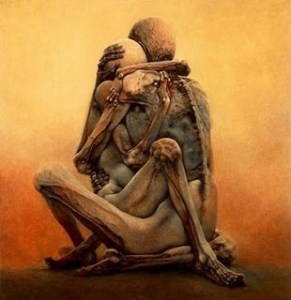
There is something about writing a blog that reminds one of the death drive. Both share the same innate desire to self-destruction, an outward manifestation away from the instinct of self-preservation.

The form insists on brevity, quick consumption, easy digestion. Summary impedes exposition in the desire to pull off a great masterful stroke, the remarkable quip, startling statement, or proof of some revered authority that we are forced to conclude that a great genius breathed through these words before passing on into the great unknown.

In truth, blogging is not an obsession with death, but rather an urge to be epigrammatic: not the urge to die as much as the urge to die well, to go out on the strongest possible terms, the climax being the start and the end, the whole point (in the full sense, the circle) of writing. Freud was wrong to describe the death drive as non-erotic aggression. It is fully subsumed to erotic desire. There is only Eros. There can be no Thanatos.

True, some blogs adopt the form of an unfolding logical argument (conclusion, evidence, evidence, counter-evidence, refutation, summation). The best blogs, however, are driven on by a kind of mad impulse: truth forms a background radiation in which hidden passions are allowed to come to full force. Truth is often assumed and, therefore, hardly in need of repetition. Indeed, repetition is the great sin of blogging. In boredom and nervous anticipation we ask what’s next?

What we yearn for are the great conflicts – the powerful contests of minds, the exposing of failure or weakness in our opponent that in our race to final exudation we end up committing the very same errors we charge our fellow combatants with. Politics? We have no politics, only polemics.

The closest art form we have to writing a blog is pornography. Pornography in style and form, is anti-narrative. The narrative is merely a ploy. The real desire is to strip away the pretense of form to get to a kind of self-referenced truth: to expose life as simple and pure delight and vulgarity. Here there are no narratives, only the reality of the obscene baseness of life.

But, it may be objected, the true virtue of blogging is discursive, the sharing and debate of ideas. But the journey always leads us back to the quick end, to the great divide, the break wherein the silence between posts rests the true heart of blogging – the decision, the what’s next?


Hieroglyphic Writing

image.png

I am intrigued by the idea of writing an entire book using only emojis. In their current incarnation, it is not possible to render a coherent story. But that’s not to say that at some time in the future it may be possible. Indeed, the emoji might well be on its way to becoming the language of the future.

I scroll through my Phone searching for the “right” kind to use. There is no right kind. Nothing represents what I feel like saying.

Adorno’s theory of mass-culture comes to mind – I know, I’m weird – the culture industry of film, tv, ads, pop art forming a language of images, a hieroglyphic writing.  Could emojis be the next logical step in the symbiotic system of mass production ~ mass consumption? Per Adorno, this is a language of domination creating the psychological needs to perpetuate the consumption of capitalist goods. But this can’t be entirely correct. Something is lost in the economy of transaction. We can’t go from automation to imagination without noticing that behind this language there is a real person. False consciousness cannot circumvent true consciousness without abandoning the instinct of liberation. I imagine the language of our shared world is already both false and neurotic. Automation simply improves upon the process.

There must be another language at work, hidden in this process, one that resists all transcription. It is a language without words, without the imposition of form, a kind of proto-music. We secretly yearn to give voice to that instinct by calling it individual. But it cannot be transcribed into the language of the everyday world. Whenever the two attempt to unite, the former is lost in a cloud of mist. Ambiguity.

I write from that instinct, realizing that the language of the everyday will force me into making definitive choices, imposing its own logic, progression, rhythm and time. As writers, it is useless to try to resist this domination of the written word. We only try to give voice to that instinct.

This might explain the appeal of emojis, a true hieroglyphic writing. At a superficial level, they seem to represent common emotions, or shorthand questions and answers.  How do you feel? 😀😏😒🤔😟😔😫😤😱😨😢  These imply emotional states. But at a deeper level, there is something ambiguous, allowing some part of the exchange to be left unspoken. The icon both captures and resists. That is me, and that is not me.  The language of the everyday does not work like this. It imposes its form compelling us to embrace its identity as our own. The instinct of liberation impels us to escape from the dominance of form, the urge toward the hieroglyph.

Théâtre de la Cruauté

ArtaudIs it possible to bring Artaud’s Theater of Cruelty into the form of a novel? On the one hand, this seems counterintuitive. The dynamic expression of space combined with the physical presence of the audience make theater unique. Do not misunderstand the meaning of the word cruauté. Artaud’s fear is only in subjugation by the written text. Liberation is rediscovered through the lost language somewhere between gesture and thought. Only then will we be able to rediscover and reconnect with the “renewed exorcisism” of animated, organic, untamed life.

This language cannot be defined except by its possibilities for dynamic expression in space as opposed to the expressive possibilities of spoken dialogue.

On the other hand, the novel is perhaps most suited to his task. There are no limits to any number of possible dynamic spaces created. This is too often dismissed by literary criticism which continues to privilege form above expression. Whole worlds live inside (and outside) the novel.  As to physical presence, the connections forged between reader and author often surpass the intimacy of presence.

It is not surprising that Artaud stands accused of giving us “impossible theater”. The audience is essential to achieve the inspiration, but often is the greatest obstacle. There are only so many tricks, bells, whistles, noises, or screams to try and shake us out of our passive watching.  We are quite content with our passive reception. We are voyeurs, protected by the safety of a shroud of darkness.

This Theater may not be particularly suited for live performance. Artaud looked for any number of ways to overcome this “natural” resistance. He suggested doing away with traditional seating, placing audience members in the center as the actors perform around them.  Perhaps turning the lights on at unexpected times might jolt us into new forms of expression. But these can easily descend into shtick.  The pendulum of transgression might swing from time to time, but the tendency is to return to the equilibrium of the spoken dialogue.

So the question I start with goes unanswered. The novel may yet prove to be the proper forum for this inaugural performance, for the simple fact that the real theater exists in the combined space formed by the minds and imaginations of author and reader. Whether it will work remains to be seen. Nevertheless, we can and must dare attempt such a thing if we are ever to break free from the iron cage of modernity. We avoid Artaud’s manifesto at our risk.

Chou-Li

The work on my third novel about a Chinese philosopher continues on pace. It was not my intention to take up a third book while leaving the last two in limbo awaiting editorial review. The need to dabble and write, though, was strong. My happiness depends on it. Plus, I had the shell of something in place which is easier, I suppose, then starting from scratch.

All three books, in fact, began as shells over a decade ago. Very little was good. Most of it was terrible. But the shells spoke to something bigger. There was something there. It just needed time. But that’s a risky proposition, because time is something we don’t have.

What was I waiting for?  I don’t know. And yet there is no way I could have written these same books back then. As surely as I could not write them ten years from now when my interests turn to other things.

Unlike the first two books, Chou-Li feels like a wonderful trip down memory lane, meeting a childhood friend who hasn’t changed one bit. It’s a style of writing so familiar and yet so foreign to me. I am forced to rediscover lost parts of my personality and humor. Was this the way I really wanted to write? I can’t say.

I think that is why it is best to never bury our worst writing. Share it. Read it out loud. Listen to its voice, the lilting manner and lyrical quality. And if it sounds wrong, that’s only because it isn’t right. Not yet.  But knowing that is why we are writers.

I take full responsibility for my bad writing. I alone bear the shame of its terrible execution and garbled syntax. It’s not a surprise. I wrote to my ear. Still do in fact. Writing is musical to me. The pace and melody reign supreme. Imagination, filling in the spaces come later as an afterthought.

Resistance

This is the beginning of a love affair, I hope. One in which we never set eyes upon each other. A perfect love. A love without the need for physical presence beyond the subtle embrace of keen understanding. It is empathy that gives rise to the need for love, the strongest desire for self-preservation, hoping to find our reflection in someone else’s eyes.

So we begin.  But since all beginnings are nothing more than a presumption, I presume to speak. You presume to listen. The unequal terms are set even before the journey commences, I confess.

Like all love affairs, this too begins with a confession. I am well aware that my love of writing is almost equal to my hatred of reading. It’s not a good quality to have in a writer and points to an inability (some might say immaturity) to engage in self-criticism. For me, writing is not a form of escape, nor self-expression. (It’s at this point my mind wishes to further explore the idea that self-expression is a form of escapism, wishing to create another face than the one given to us, but I will resist the temptation.)

What then is writing to me?

Resistance. That is the word I am looking for. It best describes the act of writing, the single greatest revolutionary act one can perform, a sum greater in impact than all the regicides and wars put together. I resist everything the world has ever shown me. I resist the need to give into self-criticism, refuse to let my self stand in the way of the work. The best time to write is when you least feel the urge.

Resist the temptation to give in to embarrassment. It is a powerful force, embarrassment, powerful enough to overcome the instinct of self preservation and self-perpetuation. Resist it. If the world wishes to judge, so be it. You and I are in no position to judge our love of writing.

Not to say one must become an empty vessel from which the lovely Erato spills forth her madness. Even the most imaginative writing should be done fully conscience. A revolution done with purpose is dangerous; thoughtless, it is deadly. I suggest only we maintain a healthy respect for our craft at all times, a passion for the intense hours of labor ahead. Write ten hours to produce one good line, and sleep well, knowing it was a productive day.

Above all, resist the forces of the world. The source of our inspiration comes only from that. Never from the moon itself, but from the shadows neath the waters stir this life. Never forget this love of ours is dangerous, deadly, perverse, obscene. Demanding to love in an undeserving world is our greatest gift.