
I seek liberation, not salvation. Liberation involves work, “an active process, a process of learning and engagement” whereas “salvation comes about through external grace, or through renunciation.”
Secrets II
“The fate of secrets are obscured in the mists of history.”
Fortune Cookie
The work will teach you how to do it.
Sad Art
I am the saddest painting in the museum. I hang in a dark, quiet corner easily passed over. The paths of the hall do not encourage my discovery. Few see my walls, although I am open and accessible to all. To get here, I’ve had to live countless innumerable lives and at great personal sacrifice. I poured my guts, thoughts, passions, time, energy, devotion, love, pain into my singular work of expression. To watch the empty blank faces pass me over is really quite sad. Sometimes, someone will come along, pause to linger at me for a few seconds, before pressing on, turn and walk away. I make no impact. No one stands to gawk at me. No one debates me, or discusses me. No one validates my existence by showing any genuine response. No one is moved to tears. Oftentimes they don’t even stare, they decide immediately, instantaneously and for reasons unknown to me and maybe unknown to them, that there is nothing appealing in me or worthy of their time. I am not an important work. Better to seek out the really important works, the ones others have judged superior, to go along with the consensus view because taste can not be judged or made poor. Occasionally someone will stop for more than a few seconds. A superior artist, come to judge my fitness, to puzzle over me for awhile. But eventually they too will give up, put me away, deem the puzzle either unsolvable or all too easily solved. There is no lasting importance here. Sad art, sad wall, sad museum.
Gossip
“Recent studies have shown that as much as 60 percent of our conversation today is devoted to gossip!” That’s just the kind of thing I’d expect that weirdo to say.
Free Will or Agency?
There are philosophical ideas that run headlong into the scientific method that generate strange debates. Not the fruitful kind, but ones that feel more like semantics and equivocation. The best example is the zombie debate between free will vs. determinism. Really? This again? I can’t wrap my head around it. Are there philosophers still asserting that there is something intrinsically non-physical about human agency? At a certain point, we coarse-grain the distinction away. I have agency. I can reach for the pen, or not. This is not free in the sense that an absurd number of causal factors went in to constitute my ability to make that decision (evolving from a single cell organism to a fully constituted human being with arms, fingers, an opposable thumb, nerves, spinal cord, and a brain). Nor is it against my will (God, or Jigsaw, is not forcing a gun to my head demanding a hard choice). The choice is to all extent and purposes superfluous, for Natural Selection gave me the power to choose and will ultimately decide whether my choice was a wise one. Is this free will? No, it’s an intentional act, it’s agency. Physical systems have evolved to allow some things (me, you, alive things) to be able to perform intentional acts. The mystery is why anyone thinks there is a metaphysical mystery.
The other side of the debate sometimes pushes the line too far. In an attempt to assert the undeniable fact that humans are governed by the same laws of physics as rocks (yawn), a hard determinism attempts to deny intentional acts. Wait? I thought we were debating free will? Are we now denying the existence of volition in general? Oh please. No one seriously believes this. When the waiter gives me my choices to drink “coffee, tea, or water” and I say coffee, am I supposed to curse an evil God who secretly programmed me to make the decision he alone wanted? What kind of madness is this? Push that line of thinking and you’ve not elevated determinism. You’ve simply elided a key distinction between life and non-life. One of the reasons I am able to distinguish rocks from life (a key differentiator) is an ability to produce a complex range of directed, purpose-driven behavior. The choices are the environment, life negotiates that space. And we call this agency, intention. That’s not a rejection of determinism, hard or soft. It’s just not instructive, not instrumental to a discussion of what is happening. It’s akin to the waiter saying “Coffee it is, but what is the point? In the end we are all dead.” Technically, it’s not even true. But philosophically, it’s non-severable.
If we say a complete physical description is impossible by a strict reductionist method, that there is some secret sauce that is needed to explain intentional acts and in particular consciousness, surely we are not committing to the idea that this special sauce must be non-physical? Is free will merely an attempt to smuggle magic back into our world? Why? The world, governed by physical laws grasped by mathematical equations, is quite magical to behold. You don’t need to smuggle anything. Or better still, as artists would say, there is a magical way in which Hobbits and Elves do inhabit and exist in the world regardless that no fossil record of their physical existence will likely be found. The universe is always much larger than we initially are led to believe. The greatest act of freedom is the power of our imagination.
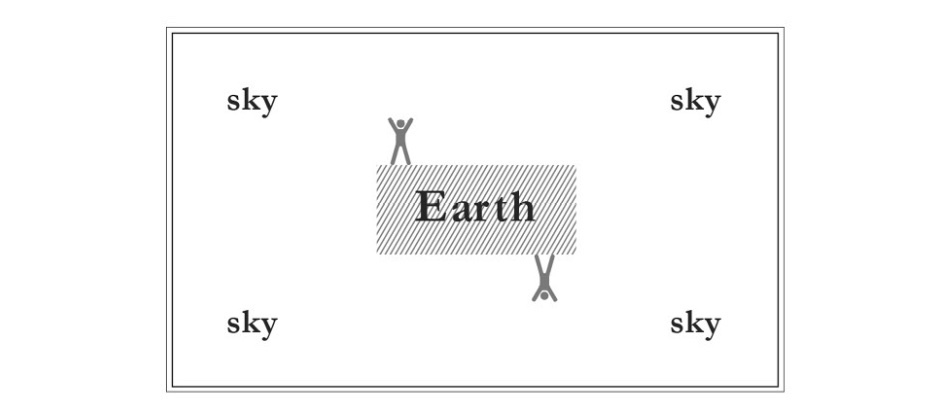
The Flat Earth Challenge
Not this:

This:
Happy Stink Rebrands
As a young boy, Happy Stink dreamed of his global empire “X-Caliber”. “It’s like an adventure story, you see? Only with an X. You know, to make it cooler.”
Notes on the Foundations of Physics
Arrow of Time: You don’t need a special initial condition. The reason entropy is lower in the past is an effect of quantum mechanics. Take the Schrödinger Equation evolving over time into a superposition of Cat Dead, Cat Alive. An electron interacts with the system, becomes entangled with the system, creating a single measurement outcome, one with a single recorded past (I’m an optimist, so let’s say Cat Alive). Decoherence guarantees the branching, one with a single recorded effect, the other branching away into the unobserved unrecorded. The future (from our position in the global wave function) isn’t recorded, therefore thermodynamic processes will always increase (entropy will always go up, increase). Unitarity guarantees that entropy will always be lower in the past because the past matters (there are less connecting branches, or better still, less complicated entanglements, correlations, configurations). To see this, let’s become pessimistic (The cat died). Let’s run our quantum experiment again, placing a dead cat into the experiment. The state will evolve to a mixed state (Dead cat 1 and Dead cat 2). We open the box, perform our measurement and…well, I’m not sure which version of the dead cat we have. But one thing my prediction can safely rule out. No miracles. The cat won’t come back to life in violation of unitarity. This also takes the mystery out of the measurement process. Measurement is quantum recording of a given quantum state. It is a basic function of quantum unitary evolution. You don’t need minds, or God. QM takes care of the whole operation. The apparent wave function collapse is explained because the past is what is measured, recorded, supervened.
Complementarity: It is built into the Schrödinger Equation, it’s what drives the branching effect. Decoherence is the process that gives the geometry that allows the architecture in which we can speak of a plurality of worlds. “The strong form of complementarity, which takes it beyond relativity, is this: There are many equally valid views of your subject—perspectives, in the general sense of that word—but they are mutually exclusive. In the quantum world, we can realize only one perspective at a time. Quantum cubism is a no-go.”
Boltzmann Brains: Black Hole entropy is fundamental. Quantum Information does not fill in the volume of space; therefore our universe is not globally ergodic. BB is ruled out. Nature is giving us an important clue, a flashing light actually at the event horizon. Warning: A (globally) maximum entropic state is not possible. Proceed with caution.
Black Hole / White Hole: Two sides of the complementarity coin. Outside, it appears as a black hole, inside it appears as a white hole, a Plank star. The energy dissipates from one universe into the creation of another universe. Biology now supersedes physics as each universe gives birth to a new one, diluting matter and radiation from one universe compressing it into low entropy, high-quality energy to start the birth cycle anew. The gate closes, and evaporates away. Another Universe takes hold. And you can’t get there unless you are there. Just like I can’t get to the 2nd BCE of Ancient China. Was information lost? From this (local) universe, yes. But globally (from the multiverse) information is retained in the glow of a New Big Bang.
A Feature, Not a Bug
The County singer Luke Combs has popularized “Fast Car”, an old Tracy Chapman gem from my bygone era. The Washington Post used the occasion as a springboard to address larger issues of race and sexual identity and the lack of representation in country music. Some pushed back, feeling the editorial was gratuitous. Can’t we just like the song? Does everything have to be about “those issues”? The back and forth commenced.
What interested me though, was the way the two camps are talking past each other. One side is asking for a cease fire in the culture wars, the other is offended at the attempt to rule out of bounds beforehand legitimate questions surrounding “those issues”. A song written by a black lesbian popularized in country music is a healthy sign, a cause for celebration. It is also an occasion to ask and raise questions because the barriers are real and still exist. The back and forth is a feature, not a bug. If the Washington Post made its argument and was greeted with universal agreement and acclaim, I suspect the real world would look much different then the world they are describing.
But it also got me thinking. Is there a sizable underground contingent of black lesbian country performers desperate but unable to cut into the mainstream? And how would a country Tracy Chapman, an undeniable whistle-popping, feet-stomping talent succeed in that market? Would she have to be careful, proceed with a subtle, covert lesbianism, or could she give it the full Cardi B treatment? In the end, it’s all about winning, I suppose. That seems to be the way America resolves these cultural disputes. At a certain point, the talent, the ear-worm catchiness converts even the most hard-hearted cynical souls. The bug is the feature. So feature the bug, front and central.
 The Hack