Notes on Inflation Theory

image

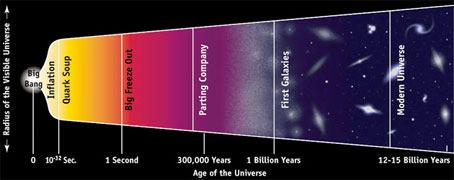
No energy is needed to create a gravitational field. The energy released in the creation of a gravitational field is negative. Energy is always released by the creation of a gravitational field. The total energy of the universe could be zero!

If gravity causes the mass of a sphere to contract, energy is released and a new gravitational field is created between the previous position and new position of the shell. Since there was no gravitational field there before, there was no energy. The creation of a new gravitational field extracts energy from the shell, decreasing the energy contained in the new gravitational field. Therefore, the final energy created by gravitational field is negative. On a small scale this is almost trivial, but on a cosmological scale, total negative gravitational energy would be significant.

Once inflation begins, it’s eternal.

There may or may not have been a beginning to the universe.

Our universe is a pocket universe, one bubble inside numerous others (multiverse). Our Universe is much larger than the observable one.

Note to Preceding

I wanted to write a post today calling it Love Starved. The idea was that simple affection, day to day reinforcement of this feeling of love is almost entirely lacking in our society. As I was saying goodbye to one of my friend’s on the phone, I inadvertently said I love you. It also happened to be true, for I very much do love my friend. It was inadvertent only because the habit of tumbling words out of my mouth is far easier when I am talking with a friend than a stranger so that the normally reserved feeling is relaxed enough for the truth to spill out. And happy that it did, for it instantly made our friendship closer and dearer to both of us. Saying we love each other is now the easiest of things. And has the bonus of being true.

But almost immediately, my mind wanted to turn from love to politics. Ugh. Bad mind.

It is curious, though, that a post ostensively about love, I should want to begin with politics. So I don’t. Instead, I pause. What is this pause? A repose? A vacation? A nightmare? Even before I begin, I am at a loss. The gap between contemplation and writing is acute. This is a fundamental part of the writing process, but one rarely seen in the final product. Is hides itself like shame.

We say this gap is a loss for words, but this is untrue. Words are never a problem for a writer. And yes I know, writers will protest this statement above all. But words are not the problem unless we think the act of writing is purely about word choice, and language is only a systemizing of words. Writers reject this by the desire to write something else, beyond words.

Nor is it a loss of an idea. The writer’s block, in this sense, is pure fiction (and not the good kind). The pause can be short, long, or eternal but it goes with the love of writing. The pause, the gap between writings can quickly turn into an anxiety about losing the ability to write, then aching for the desire to return, then paranoia.

The pause is essential to the writing process, forcing the weeds and the flowers to germinate. Is that because the weeds and flowers are inseparable? Is there a deeper connection that only the act of writing can and must liberate?

My art, my mind, my instinct are naturally aroused, forcing me into deeper contemplation about the subject. It is a glimpse of something not yet formed. Go back and rework it until the image appears before you. Writing is not simple dictation. It is maternal, annular, a spinning concentric shell.

This is why my mind and thoughts confound me. To others, I must seem incomprehensible at these times.

The real threat to writing is the loss of time spent away from the creative process. Write, read, think, observe. Do that, and you are creating. We give up our lives in pursuit of the inessential masking as the important, the day to day. So here create a refuge and resist. Shut off the phone. Or better yet, turn your phone into a character.

So here, we do not need to be perfect. Not ever. Humanity never got anywhere without error.  We should resist the urge to always be profound, the commandment that thou must always make sense for the sake of closure.  To end, though, is only a matter of this…

Inhuman

image

We create inhuman landscapes. We create inhuman landscapes and act surprised when people occupy them.

We do worse.

We blame them, condemn those to this sad fate of hopeless lives. We take the institutional, the economic, the historic, the million processes that go into making these inhuman landscapes either intentional or through neglect, and mask these obscenities by morality. You are the reason your life is terrible. There is no one to blame here but yourself.

Official Rules for Tag

image

Okay, here are the rules of “Tag you’re it”.

1) “Base” is NOT a fixed location. It’s in a random state of quantum fluctuation (quantum foam) such that it’s always changing and moving depending on the player’s current level of fatigue.

2) I am safe so long as ANY part of my body touches base. Just because my foot is off you can’t count me out.

3) Double Tagsies is BULLS#IT!! If I tag you, you cannot tag me back right away! You must allow at least three seconds time for me to pass before you can begin pursuit.

4) Being “IT” is not an instantaneous process. There is at least a second or two before my “IT-ness” transfers into your “IT-ness”. Wolfman doesn’t change into a wolf in a nanosecond. Zombies take 12 seconds before they turn, ask Brad Pitt.

Cosmology

image

Assumptions

1) Infinite, flat space – observations to date suggest that curvature is negligible and is essentially flat. You could have a Ms. Pac-Man situation where if you traveled long enough on one side of the flat surface, you reappear in the same space on the other side. Inflation theory generally predicts a flat, infinite space).

2) Uniform distribution of matter – With the WMAP, there is remarkable agreement with experimental data. The so called fractal or island universes aren’t supported by the evidence. There appears to be an upper limit to the kinds of superstructures or groupings of astronomical objects (e.g. superclusters).

3) Dark whatever’s – Even assuming dark energy could eventually rip apart matter and disperse energy so that there is no mechanism by which they can “relump” to allow a Big Crunch.

4) Quantum foam – uncertainty principle tells us that even in extreme thermal coldness near absolute zero, given a long enough period of time, matter and energy will suddenly pop back into existence which can recycle the inflationary process again and again.

5) Asymmetry – The cosmological constant. Repulsive Gravity or ate there two gravitational forces?

6) Consciousness, the soul you feel, is dependent upon a particular arrangement of molecules, atoms, etc. under specific conditions.


The Myth of Intersubjectivity

image

About a year ago, I reached the painful conclusion that intersubjectivity is a myth. Not from intellectual insight but for deeply personal reasons. A relationship that meant the world to me came to an end. The whys of course are simple. Without love, desire dies.

So it ended, but along with it, this faith in the idea of mutuality, shared experience, collective intentionality, and erotic communion. One can live a lifetime thinking that someone is within someone’s sympathetic orbit only to find that they were an impenetrable island unto themselves.

So where now? What path forward? The island of the other is not as impenetrable as first thought. There are seepages, after all, tiny eruptions of thought, emotion, feeling that break through and combine with your own. There is, in other words, a trace, discovered only in the other’s ABSENCE, their non-being, that this sense of mutuality can be appreciated, if perhaps not consciously understood. Il y a toujours un qui baise et un qui tend la joue. Out of these seepages we construct a portrait of love, a composite of mutually shared affections and infections. But it is deeply intuitive, and deeply unstable, hence all of the madness surrounding Eros. Live long enough with someone, share their mental and emotional state long enough, and these seepages will be strongly apparent.

It is the same intuition that lets you know at the precise moment, the exact second, even when you are separated by hundreds or thousands of miles in distance, when your partner is in the throes of a wild passionate embrace with someone other than you. Not a fear, not a phobia, but an undeniable certitude. This sudden onset of your own desire kindled because the seepage has carried over and penetrated your own. And this is possible because we are describing a space created by pure geometry, a pure mathematical expression prior to form, where space and time are only emergent qualities generated through the incessant laws of thermodynamics and entropy.

But if this is true, then I have no objective frame, no reference, no map to guide me, no up, no down, no forward, no back. No here, no there. There is, in the end, the frolicking play and dissipation of heat. And upon this radiating force, we are asked to construct our idols, palaces, gardens. God could do no better.

The Sickness Unto Death

image

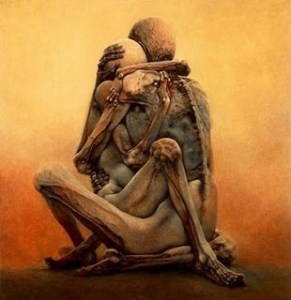
The sickness unto death is despair. Despair from failing to align ourselves with the eternal, with the fact that our life, our existence is eternal. Combined with the realization of the eternal reoccurrence of all events, we can see how strong is the urge to self-extinction.  The despair which proclaims “no more! not this life! Anything but what I am!” Happiness comes when we our briefly reconciled with the eternal, and wish for the perpetuation of life. Despair is the revulsion, the desire to escape our existence.

I am convinced that you and I will live out this exact same existence again and again forever. I am convinced, not as the fanatic who must believe despite all evidence to the contrary, but as the scientist can be convinced of some physical reality like global warming. If the universe is sufficiently large and uniform, and assuming quantum processes are in place, there are only a finite number of configurations in a given volume of space. The reoccurrence follows merely by chance. Add in some inflation cosmology for good measure, and we have a system that mimics any biological system under conditions of evolution – that is to say, as an algorithm. Designing an eye may seem impossible, but once nature has struck upon it, it will continue to traverse that same ground. We are the well worn path of future universes.

Biological? Yes. Meaning self-perpetuation in the face of self-extinction. Travel far enough in space and eventually you will begin to encounter similar beings that look and act like you. Eventually, you will come across your exact doppelgänger, matching your life moment by moment.

I am a hard core materialist. Any system designed to appear the same as me, shall be judged as me. Descartes missed a step. It is not enough to think about existence. One must seize existence, affirm it. Reject the sickness unto death.

The agony and revulsion of the eternal comes in full force. You mean a person born into slavery and dies in slavery, must live that enslaved existence for all eternity? Yes it does. But it also means justice is real, even if it is wanting. Wait! The child who falls ill, and dies from a painful cancer, are they destined to live the same fate forever? No, no! This can’t be right! This must be hell!”

This is the sickness unto death. We must always guard against this despair, this secret yearning to murder our own souls in the hopes of some unfounded liberation. You are eternal. Your life, perhaps a miracle or a curse. Respect it. Seize it.

Negative Liberty


imageThere are benefits to philosophical misreadings. Ayn Rand made a career out of misreading Kant, building an entire philosophical universe to refute something Kant never said nor implied. Now, whenever I happen to glimpse aspiring John Galts pop up from time to time like so many underground revolutionaries, I am left with the amusing image of Ayn Rand as some giant Samuel Johnson monster kicking synthetic a-priori pink unicorns in the ass. I refute thee thus! This too is comedy.

The largest benefit, by far, is inversion, or if you like, comedic inversion. Why? Or better still, why not?  Inversion allows one to traverse the flowing currents of thought left untravelled by the great minds, of possibilities unexplored, territories unclaimed, to reach beyond the tyranny of settled ideas and expert consensus.

For present purposes, I am interested in Herbert Spencer and his notion of a liberal or rational utilitarianism. Spencer’s (willful?) misreading of Kant opens up the amusing possibility of an inverted reading of Spencer qua Kant. Allow me the indulgence, for it is an idea not so clear in my own head, and therefore entirely valid as an exercise in constraint. I mean philosophical constraint.

“Every man is free to do as he wills, provided he infringes not the equal freedom of another man.” Spencer’s maxim extols the virtues of “Negative Liberty” – the absence of constraint, state interference, a zero sum game between equality and Liberty. But it also involves a sleight of hand. Negative Liberty subsumes the entirety of Liberty itself if it is to be instructive (read: moral). All Liberty is negative. Positive Liberty, that hypothetical other serving as mere intellectual abstraction, is effaced, banished into the rhelm of pink unicorns in order to turn Spencer’s maxim into a categorical imperative.  And rational too! These are the indefensible moral rules created for perfect moral human beings. Utilitarianism (teleological) becomes concrete and objective (deontological) as soon as all moral choices are willed into either/or forms of the universal law. Choose or die.

Wait? Did I just imply two competing ethical systems are one and the same? It seems I did.

I push this joke no further. There is a danger in subjecting everything to inversion. Push things too far, and philosophy become mere rhetoric.  And objectivism is actually supernaturalism, and empiricism is idealism, and communism is fascism, and capitalism is socialism, and enough. That joke isn’t funny anymore.

Hopefully, my amusing exercise was not entirely in vain. Spencer’s ambiguity is ours, a tension between essential choices and accidental exigencies glossing over a confusion about the trade offs between Liberty and equality. Think of what informs our contemporary moral debates. What is the right way to eat? To think? To act? To seek pleasure? To behave? To dress? To look?  As the number of potential freedoms increases, so to the individual becomes the subject of increased doubt and debate. The individual is not a problem for modern society, but the problem. Quintessential.

From this ground, a thousand ethical formulas now spring to life. The ancient problem “What is the good life?” becomes “What is the good life for me?”. “What is the essence of man?” now becomes “Who am I?” We no longer seek a universal ethic but rather inhabit an ethical universe. Why then do we not simply apply some much needed liberal tolerance to account for such diversity of taste, creed, belief, expression, sexuality, etc.? Surely the principle of negative liberty should apply to the level of personal expression as well, and we should simply accept this diversity and relativism with a healthy bit of liberal tolerance? And yet we do not, for else how does we explain the increasing splintering, factionalism and tribalism of our day.

So it would seem that negative liberty is not so deeply cherished, and survives more as a kind of moral reprove masking a deeper mistrust of our fellow citizens. We suspect that ethical diversity threatens that older, more entrenched morality that demands that the individual conform to a uniformity of type. It is Aristotelian throughout, the idea that a person must become what they are by nature compelled to be. In truth, the liberal ethic only penetrates the surface, while the deeper currents of Western morality do not allow such a tolerant stance. It is our inability to rid ourselves once and for all of this belief in “essences”, that prevents us from adressing a true Liberty, free from the burden of formalism.

The Self as Map or Model

image

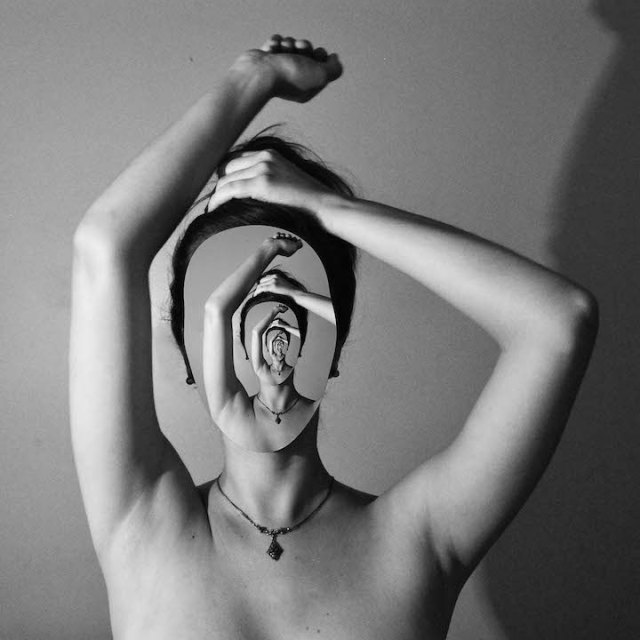
It is not at all clear why the phenomenological experience should take the Self as its starting point of investigation. The Self seems to be an, as yet, untested hypothesis, itself in need of empirical justification. Far from being foundational, we are now aware how late the concept of the Self is in human development (see the work of Daniel Dennett and Thomas Metzinger).

It is no longer satisfactory to speak of the Self with one voice. Rather, there is a plurality of selves, multiple voices, overlapping and discontinuous, a map without definitive boundaries or horizons of experience. There is, first of all, the so-called “minimal self”, primitive, immediate, rooted in the neurological structure of the brain. There is the “narrative self” acting as a continuity of memory and personal identity, a rich tapestry of stories, encounters, reflections, deceptions. There is the “social self” mirroring and absorbing its surroundings, the environment of culture, beliefs, norms. It would seem that our basic starting point was no longer a single point at all, but a diffuse, decentered mode of experience.

Still, the desire for unity remains. It is hoped that if we could only discard what is secondary and inconsequential, we will arrive, at last, at a basic substratum, an immediate or primal constitution that we call the “real” Self. It is hard to rid ourselves of the metaphysical conception of “essence”.

It is to this end that AI mapping hopes to unveil the “essence” of cognition, and incidentally, also while it will fail for the problem of the Self is not one of essences, but rather of discontinuities.

The notion of an “essential self” would seem to involve not a single, fixed element by which we can identify and name something, but rather, a way of relating to things. The problem with such an approach, as Derrida points out, is that it ensnares us in the metaphysical quagmire, that of “self-presenting = the present”. Moreover, phenomenological experience assures that no single identity could exist across a given amount of time. Instead of a Self we have what might be called self-situations. At best, we might hope to replace the notion of the essential with something akin to an organic biological conception.

The Problem with Eternity

image

There is something about writing a blog that reminds one of the death drive. Both share the same innate desire to self-destruction, an outward manifestation away from the instinct of self-preservation.

The form insists on brevity, quick consumption, easy digestion. Summary impedes exposition in the desire to pull off a great masterful stroke, the remarkable quip, startling statement, or proof of some revered authority that we are forced to conclude that a great genius breathed through these words before passing on into the great unknown.

In truth, blogging is not an obsession with death, but rather an urge to be epigrammatic: not the urge to die as much as the urge to die well, to go out on the strongest possible terms, the climax being the start and the end, the whole point (in the full sense, the circle) of writing. Freud was wrong to describe the death drive as non-erotic aggression. It is fully subsumed to erotic desire. There is only Eros. There can be no Thanatos.

True, some blogs adopt the form of an unfolding logical argument (conclusion, evidence, evidence, counter-evidence, refutation, summation). The best blogs, however, are driven on by a kind of mad impulse: truth forms a background radiation in which hidden passions are allowed to come to full force. Truth is often assumed and, therefore, hardly in need of repetition. Indeed, repetition is the great sin of blogging. In boredom and nervous anticipation we ask what’s next?

What we yearn for are the great conflicts – the powerful contests of minds, the exposing of failure or weakness in our opponent that in our race to final exudation we end up committing the very same errors we charge our fellow combatants with. Politics? We have no politics, only polemics.

The closest art form we have to writing a blog is pornography. Pornography in style and form, is anti-narrative. The narrative is merely a ploy. The real desire is to strip away the pretense of form to get to a kind of self-referenced truth: to expose life as simple and pure delight and vulgarity. Here there are no narratives, only the reality of the obscene baseness of life.

But, it may be objected, the true virtue of blogging is discursive, the sharing and debate of ideas. But the journey always leads us back to the quick end, to the great divide, the break wherein the silence between posts rests the true heart of blogging – the decision, the what’s next?